Children learn early that 8 is greater than 4, then meet fractions and find that \(\Large\frac{1}{8}\) is smaller than \(\Large\frac{1}{4}\). As children encounter new mathematical concepts, they sometimes need to rethink what they learned earlier.
You may hear that “maths gets harder” in the later primary years, at the move to secondary school or at certain points in the school year. Children experience those demands in different ways, and they get a sense of achievement when they see how mathematical ideas connect.
With that in mind, we’ll look at how maths changes from Year 1 to Year 11, how children’s mathematical thinking develops and how you can encourage that development at home.
What Changes in Maths as Children Progress Through School?
Each stage of school maths introduces new content and builds on earlier years. Children start with counting and place value in Years 1 to 2 and work towards GCSE Mathematics in Years 10 to 11.
The National Curriculum for Mathematics in England sets out how content and expectations develop across primary and secondary education. The stages below start in Year 1, as Reception follows the Early Years Foundation Stage.
Here's a closer look at what children learn at different stages:
-
Years 1–2: Early maths focuses on counting, place value, addition and subtraction, alongside the foundations of multiplication, division, fractions, shapes and measurement. Lessons introduce number facts and simple problems to build mathematical fluency.
-
Years 3–4: The curriculum extends to larger numbers, more demanding calculations, multiplication tables, fractions and decimals. Problems increasingly require several steps, while children develop their ability to explain their methods and check their answers.
-
Years 5–6: Fractions, decimals and percentages become more complex, with ratio, proportion and introductory algebra also entering the curriculum. Children work with a wider range of mathematical information and choose appropriate methods for solving problems.
-
Years 7–9: Secondary maths develops algebra, proportional reasoning, geometry, probability and statistics in greater depth. Students use equations, graphs and mathematical rules more extensively, including in problems that bring together knowledge from different topics.
-
Years 10–11: Students work towards their GCSE in Mathematics. They extend their algebra to quadratic equations, simultaneous equations and inequalities, and solve more demanding problems that draw on number, geometry, ratio, probability and statistics.
Across every stage, the National Curriculum aims to build fluency, reasoning and problem-solving. Children explain their thinking and choose their own methods as the tasks become more demanding.
📕 You May Also Like: Why Being Good at Maths Looks Different in Primary and Secondary School
How Children's Understanding of Numbers Develops
Children learn that reasoning which works for whole numbers needs adapting for fractions, decimals and percentages. We can see this most clearly when we compare whole numbers and fractions.
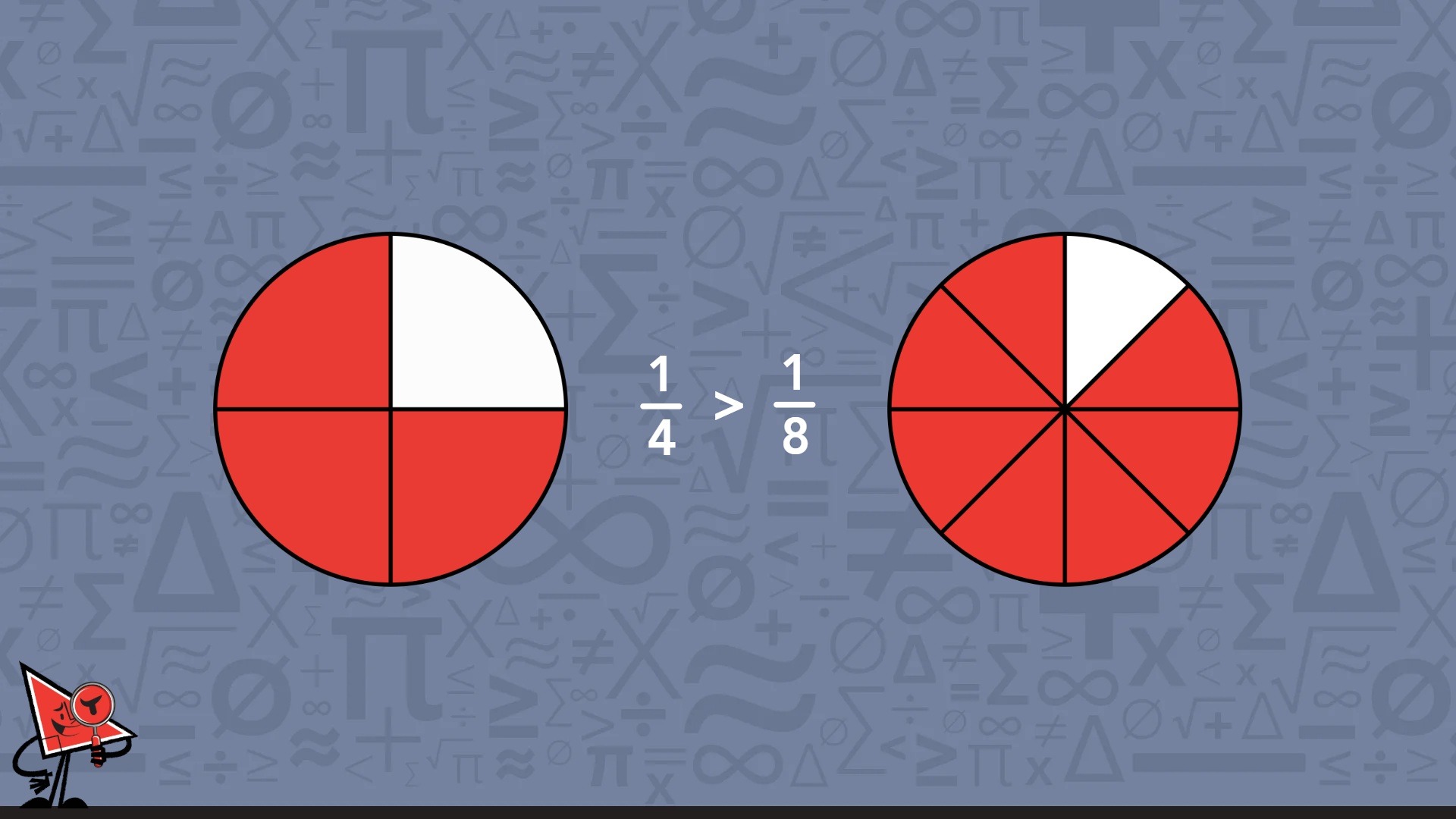
With whole numbers, a larger number represents a greater quantity, so 8 is greater than 4. However, the same reasoning may lead to a different conclusion with fractions. For example, \(\Large\frac{1}{4}\) is larger than \(\Large\frac{1}{8}\), even though 4 is smaller than 8.
To understand why, consider what happens when we divide the same whole into equal parts. If we divide it into four equal parts, each part is larger than if we divide it into eight. The denominator tells us how many equal parts make up the whole, so a larger denominator means smaller parts when we're comparing unit fractions of the same whole.
Researchers describe the tendency to apply whole-number reasoning to fractions as whole-number bias. A Developmental Science study of US children found that reliance on this reasoning fell between fourth and eighth grade, roughly Years 5 to 9 in England, although the pattern varied between children.
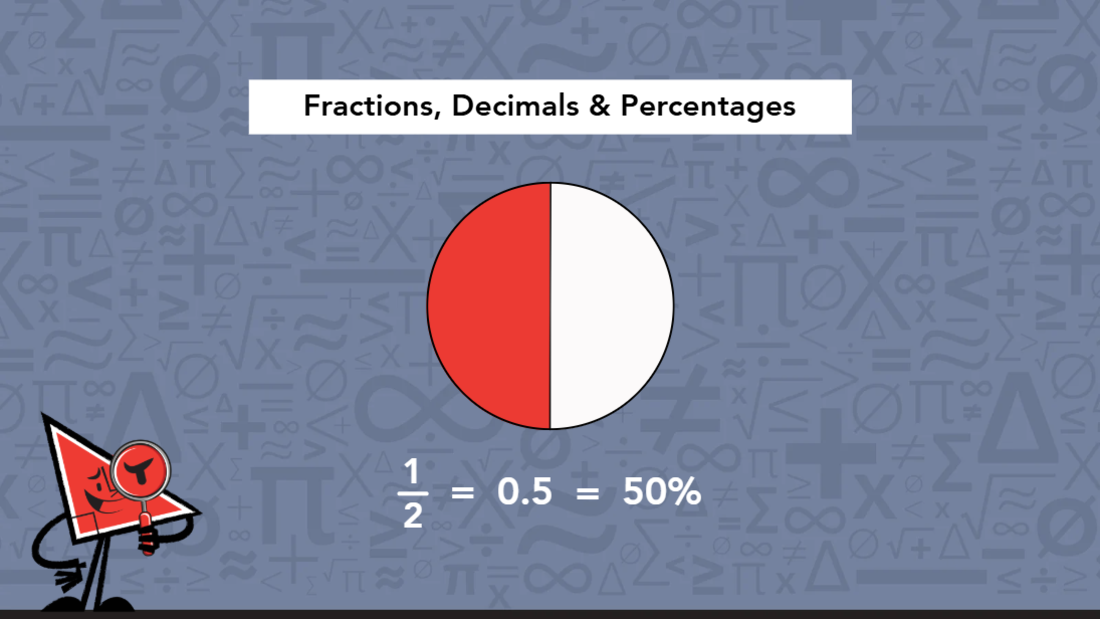
Children also develop a more flexible understanding of numerical value as they learn to recognise the same quantity in different forms. For instance, \(\Large\frac{1}{2}\), 0.5 and 50% represent the same proportion as a fraction, decimal and percentage respectively.
To understand how these forms relate to each other, children learn to move between different representations of a value, compare quantities and use numbers in different mathematical situations.
📕 You May Also Like: Why Fractions, Decimals & Percentages Confuse Your Child
How Children Learn to Recognise Mathematical Relationships
Children gradually learn to recognise relationships between numbers and operations, which allows them to build on familiar calculations, solve new problems and explain why their answers make sense.
To illustrate, consider the relationship between multiplication and division. If 6 × 4 = 24, we have six equal groups of four. If we divide 24 into six equal groups, we get four in each group, so 24 ÷ 6 = 4. Multiplication combines equal groups into a total, while division can reverse that process to find the size of each group. This is why we call them inverse operations.
Children can also use known multiplication facts to work out related calculations. Since 6 × 4 = 24, they can reason that 7 × 4 = 28 because seven groups of four contain one more group of four than six groups of four. Instead of calculating from the beginning, they use the relationship between the two facts.
As they progress through school, children also learn to recognise equality, or how the values on either side of an equals sign compare. In 7 + 5 = 6 + □, both sides must have the same value. Since 7 + 5 = 12, the missing number is 6, making the right side equal to 12 as well.
Children can build on their understanding of equality and inverse operations when they begin working with algebraic equations, where letters can represent unknown numbers. For instance, in x + 8 = 12, they can use subtraction, the inverse of addition, to work out that x = 4.
At GCSE, students build on this reasoning to solve quadratic and simultaneous equations.
📕 You May Also Like: How to Do Long Division: A Step-by-Step Guide
How Can You Encourage Your Child's Mathematical Thinking at Home?
You can support your child's mathematical thinking through everyday conversations, games and opportunities to explain how they reached an answer.
By asking questions and discussing different approaches, you can help them make sense of mathematical ideas and connect new problems to what they already know.
You might try some of the following ideas at home:
-
Ask how they worked something out. If your child solves a maths problem, invite them to explain their approach. You might ask, “How did you know where to start?” or “Could you work it out another way?” Their explanation can help you see whether they understand the reasoning behind their answer.
-
Bring maths into everyday activities. Shopping, cooking or planning journeys give children opportunities to use numbers in practical ways. If you're planning a journey together, you could look at departure and arrival times and work out how long the trip will take. You might then discuss how leaving earlier or later would affect your arrival time.
-
Look for patterns during play. You could arrange coloured building blocks in a repeating pattern, such as red, blue, red, blue, and invite your child to continue it. Once they've spotted the pattern, ask how they knew which colour came next or whether they could create a different pattern of their own. Older children can look for similar relationships in number puzzles and games.
-
Help them find a starting point when they're stuck. If your child is unsure how to solve a homework question, encourage them to identify what they already know or recall a similar problem they've solved before. Give them time to try an approach before offering further guidance.
The Education Endowment Foundation offers further advice on supporting maths at home, including games and mathematical conversations for younger children and ways to encourage older children's learning.
Even if some of the methods your child learns at school are unfamiliar to you, your interest in how they think and the questions they ask can help you support their developing understanding.
Mathnasium instructors also encourage children to explain their mathematical reasoning through Socratic questioning. They guide children through concepts by asking how they reached an answer and why a particular method works, while encouraging them to think more deeply about the maths involved.
📕 You May Also Like: How to Help Your Child Through Their Maths Homework Without the Stress
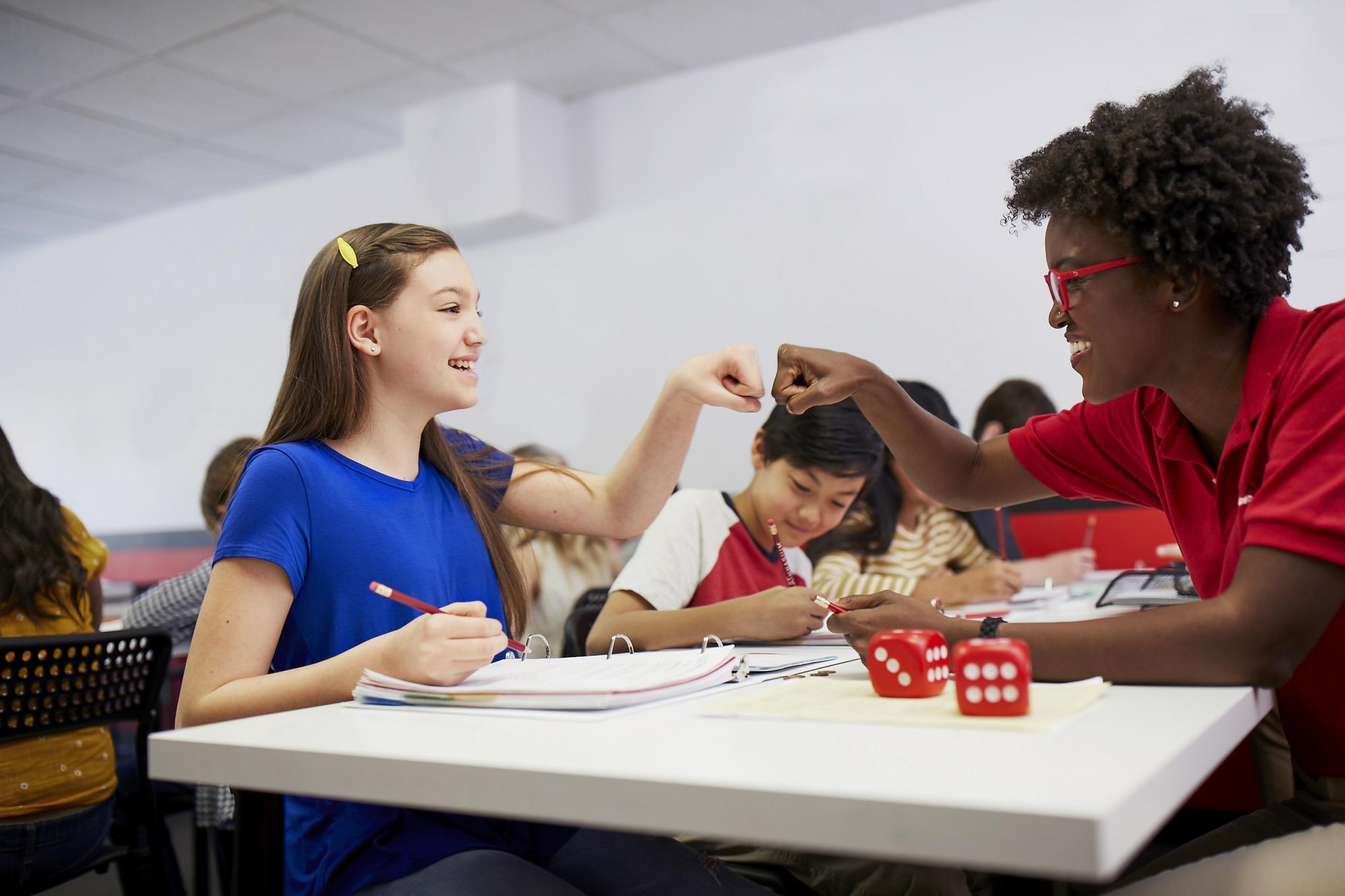 From early years through to secondary school, Mathnasium supports children at every stage of their maths journey.
How Mathnasium Supports Children's Maths Development Through School
Mathnasium is a maths-only learning centre dedicated to helping students of all skill levels excel in maths.
From the first number concepts in primary school to more advanced secondary maths, children's learning needs change as they progress. Mathnasium supports children from Reception through to GCSE, helping them strengthen their foundations, address gaps in understanding or take on greater challenges when they're ready.
We deliver this support through the Mathnasium Method™, our proprietary teaching approach designed to help children build maths mastery through deep understanding. Our approach includes:
-
Assessment and customised learning plans. Every child begins their Mathnasium journey with a diagnostic assessment that identifies what they already know and where gaps remain. We use the insights to create a bespoke learning plan that addresses those gaps, builds on existing knowledge and provides greater challenge where appropriate.
-
Teaching for understanding. Our specially trained instructors use mental, verbal, visual, tactile and written techniques to teach concepts in different ways and develop a deeper understanding of how and why maths works.
-
Face-to-face instruction. Children work face-to-face with specially trained instructors at a pace that's right for them, either in-centre or through live online tutoring.
-
Confidence and engagement. Sessions include games and earned rewards that encourage children to participate actively and engage with maths. As their skills and understanding develop, children can also grow in confidence and develop a more positive attitude towards maths.
The impact extends beyond the classroom:
-
94% of parents report an improvement in their child's maths skills and understanding
-
93% of parents report their child's improved attitude towards maths after attending Mathnasium
-
90% of students saw an improvement in their school grades
With over 1,250 centres worldwide and over 40 across the UK, there is likely a Mathnasium centre near you.
Families across Wimbledon Town and Village, Southfields, Wimbledon Park, Wimbledon Chase, Merton Park and Raynes Park trust Mathnasium of Wimbledon to help their children build lasting maths confidence.
Whether your child needs to make sense of new mathematical concepts or is preparing for more advanced school maths, our team is ready to support their progress.
✉️ Click Contact Us to get in touch with Mathnasium of Wimbledon
Not near Wimbledon?
📍 Find a Mathnasium Centre Near You


 0207 550 6100
 07845671964