Unless they were enrolled in a summer program, most children return to school after several weeks with relatively little contact with maths.
The autumn term then brings a step up in difficulty as your child builds on concepts from previous years, including those they know well, those they may have forgotten and those they never fully mastered.
Today, we’ll look more closely at why maths struggles may become more apparent as the school year progresses, what they may reveal about your child’s learning and what you can do if difficulties continue.

Why Maths Difficulties May Become More Noticeable During the Autumn Term
When we refer to maths difficulties during the autumn term, we are talking about when they may become noticeable, without suggesting that the season itself causes a particular maths problem.
Several factors can help explain why difficulties may become clearer during the term.
-
Maths performance may decline over summer. For some children, this may help explain why they struggle more when lessons resume in autumn. Research reviewing children's academic outcomes found that numeracy measures covering maths concepts, problem-solving and reasoning frequently declined over the holidays, although results varied across studies.
-
New work can draw more heavily on earlier learning. Other difficulties may emerge as the autumn term progresses and children encounter new maths. The curriculum expects them to connect mathematical ideas and apply what they know to increasingly complex problems, so earlier skills continue to play a part.
-
Gaps can remain hidden at first. Some younger children can follow current teaching for a significant time despite gaps in their knowledge, particularly with extra classroom support or more time to calculate.
As the term progresses, those gaps may become clearer when children need to apply the same maths in different ways. Your child may understand a concept in one context and find it harder to use in another.
Across the term, questions, observations, discussions and assessments can show whether that difficulty recurs and where support may be needed.
📕 You May Also Like: First Half-Term Maths in Primary School: A Parent’s Guide
What Your Child's Struggles May Reveal About Their Maths Learning
Your child’s maths struggles can give us clues about which part of their mathematical knowledge needs support. If fractions are causing trouble, for example, the source could be multiplication facts they need for the task or difficulty deciding how to approach a problem.
Children can have strengths in one part of their mathematical knowledge and weaknesses in another, so we need to understand what is causing the struggle before we can identify the most useful support.
Let’s look at four patterns that can help us identify which areas may need more attention.
1. Earlier Maths Knowledge Can Affect Current Work
Maths concepts build on one another as children progress through school, so difficulties with current work can sometimes be traced back to an earlier skill that is not yet secure.
In Year 6 fractions, for example, children draw on their prior understanding of common factors to simplify fractions, as set out in the DfE guidance.
Let’s say your child is simplifying \(\Large\frac{6}{15}\). Before they can reduce the fraction, they need to find a number that divides both 6 and 15 exactly. For 6, they can use the multiplication pairs 1 × 6 and 2 × 3, which give the factors 1, 2, 3 and 6. For 15, the pairs 1 × 15 and 3 × 5 give the factors 1, 3, 5, and 15.
3 appears in both sets of factors, so they can divide both parts of the fraction by the same number to get 6 ÷ 3 = 2 and 15 ÷ 3 = 5, which simplifies \(\Large\frac{6}{15}\) to \(\Large\frac{2}{5}\).
If your child can complete the simplification once 3 is identified but cannot find it independently, their work suggests that finding common factors is the skill to revisit.
📕 You May Also Like: Why Fractions, Decimals & Percentages Confuse Your Child
2. Misconceptions That Cause Repeated Errors
If your child repeats the same type of error across different questions, this is known as a “systematic pattern of errors” and can point to a misconception in their understanding.
To illustrate this, children may come to believe that multiplication always makes numbers bigger because their early examples use positive whole numbers greater than 1. The rule appears to fit 3 × 4 = 12, but 0.5 × 0.5 = 0.25 because multiplying a number by 0.5 gives half of it.
Across several questions involving multiplication by numbers below 1, repeatedly expecting a larger answer shows that the “multiplication makes bigger” idea itself needs correcting.
3. Fluency With Number Facts and Procedures
Maths fluency may be part of the problem if your child understands a concept but still uses considerable effort to recall number facts or carry out a familiar procedure.
Fluent recall covers addition, subtraction, multiplication and division facts, including number bonds, while children also need to understand how familiar procedures work and where they are useful.
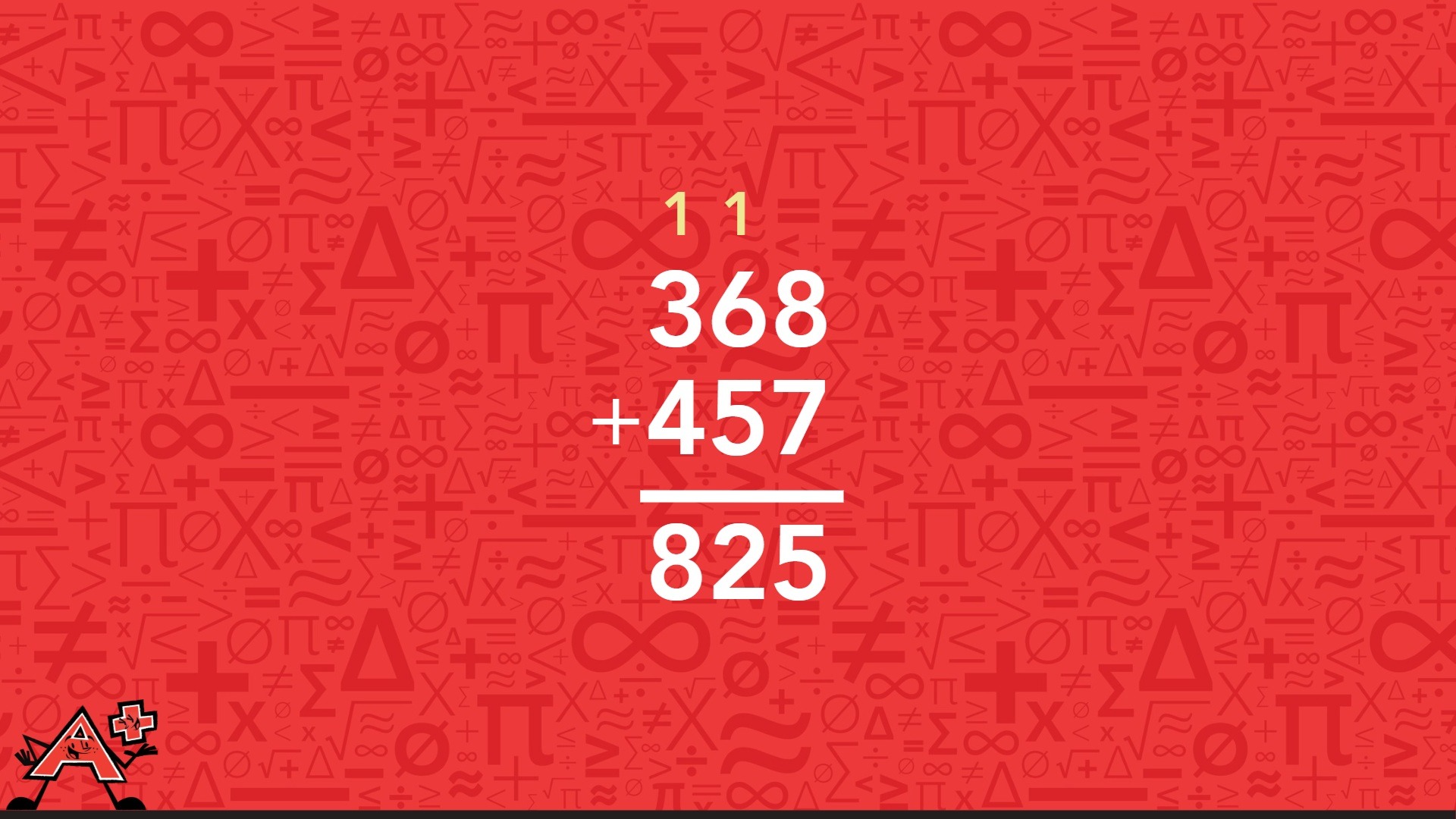
For instance, your child may set up 368 + 457 correctly using column addition. They first work out 8 + 7 = 15, write 5 in the ones column and carry 1 ten into the tens column. Next, they calculate 6 + 5 + 1 = 12, write 2 in the tens column, and carry 1 hundred into the hundreds column. Finally, 3 + 4 + 1 = 8, which gives the final answer of 825.
Your child may follow every step correctly yet need to count on their fingers to work out 8 + 7 or 6 + 5 + 1. In that case, the difficulty lies with addition-fact fluency, which is the area to practise.
For procedures, teachers can check whether your child understands how the method works, since that understanding can help them reconstruct a step they forget.
📕 You May Also Like: Column Method: How to Add and Subtract Step by Step
4. Strategies for Unfamiliar Maths Problems
Sometimes a problem uses maths your child already knows but presents it in a way they have not seen before. Your child then has to decide how to approach it and check whether their strategy works.
Imagine they need to find how many different ways they can put 30 objects into equal groups. They might group the objects in 2s, 3s, 5s or other sizes and check which divide 30 exactly, or start with all 30 and share them between different numbers of groups.
Both routes use division, but your young learner still has to organise the search and check that they have found every possible grouping. If the calculations are correct but the final answer misses some groupings, teachers can focus on how your child plans their strategy for an unfamiliar problem.
📕 You May Also Like: How to Do Long Division: A Step-by-Step Guide
How to Support Your Child With Maths During the Autumn Term
During the autumn term, you can use your child’s classwork, homework and teacher feedback together to get a clearer idea of where they need support.
If they struggle with the same concept or skill across different tasks, that gives you a more useful starting point than a single piece of work they found hard. Any assessment results the school shares can provide further information.
Your school may also use a standardised autumn maths assessment. Optional NFER maths tests for Years 2–6 can provide a base for monitoring progress during the school year and identify curriculum areas that may need more focus. Schools choose which assessments they use, so check what information your child’s school provides.
For families in our city of Winchester, the Hampshire term dates provide a local reference for autumn half-term and the end of term. The council publishes these dates for community and controlled schools, while other schools may follow a different calendar.
Whatever schedule your child’s school follows, we suggest three practical steps to support your child:
-
Choose one area to work on first. Use your child’s work and feedback from school to identify a concept or skill that needs attention. Your child’s teacher can explain how the class is working on that topic and which part would be most useful to practise at home.
-
Connect home practice with what your child is learning. Younger children can revisit maths through games and everyday activities involving counting, sharing, measuring or shapes. Older children can practise relevant number facts, return to examples from class or try similar questions from their exercise book.
-
Check how the same area is going later in the term. Look at subsequent classwork or homework and use the next feedback you receive from school to see whether your child can manage the concept or skill more independently. If the difficulty continues, you have something specific to follow up on rather than starting again with a general concern about maths.
From there, targeted maths support can focus more closely on the knowledge or skill behind the difficulty and determine what your child needs to work on next.
At Mathnasium, our diagnostic assessment identifies what your child already knows and where gaps remain, then guides the creation of their bespoke learning plan.
📕 You May Also Like: How to Talk to Your Child's Maths Teacher When You're Worried About Progress
 At Mathnasium, each child follows a bespoke learning plan, which allows them to spend time on the concepts they need to strengthen and progress when they are ready.
How Mathnasium Helps Children Close Maths Gaps
Mathnasium is a maths-only learning centre dedicated to helping students of all skill levels excel in maths.
Whether your child needs to close a gap that has become clearer this autumn, keep up with their current school maths or move on to greater challenge, we meet them at their current level and focus on what they need to learn next.
To do so, we use the Mathnasium Method™, our proprietary teaching approach designed to help children build maths mastery through deep understanding. Our approach includes:
-
Assessment and a customised learning plan. Every child begins with a diagnostic assessment that identifies their strengths and gaps in their maths knowledge. We use those insights to create a bespoke learning plan based on what they already know and what they need to learn next.
-
Teaching for understanding. Our specially trained instructors use mental, verbal, visual, tactile and written techniques to explain how and why maths works and develop a deeper understanding of mathematical concepts.
-
Face-to-face instruction. Children work directly with specially trained instructors, following their learning plan at a pace that suits their needs. Sessions are available in-centre and online, with children receiving direct instruction and guidance throughout.
-
Confidence and continued progress. Children work through their learning plan from their current level, whether they need to close gaps, keep pace with school maths or move on to greater challenge. As their understanding develops, they can build confidence and continue progressing.
The results show what this approach can achieve:
-
94% of parents report an improvement in their child's maths skills and understanding
-
93% of parents report their child's improved attitude towards maths after attending Mathnasium
-
90% of students saw an improvement in their school grades
With over 1,250 centres worldwide and over 40 across the UK, there is likely a Mathnasium centre near you.
Families across Kings Worthy, Alresford, South Wonston, Colden Common, Stockbridge, Twyford, Chandlers Ford and Eastleigh trust Mathnasium of Winchester to help their children build lasting maths confidence.
If you have questions about your child's maths progress this autumn or any other maths topic, our team is ready to help.
✉️ Click Contact Us to get in touch with Mathnasium of Winchester
Not near Winchester?
📍 Find a Mathnasium Centre Near You


 01962 671787